
On tests and age
...and age being our ultimate test

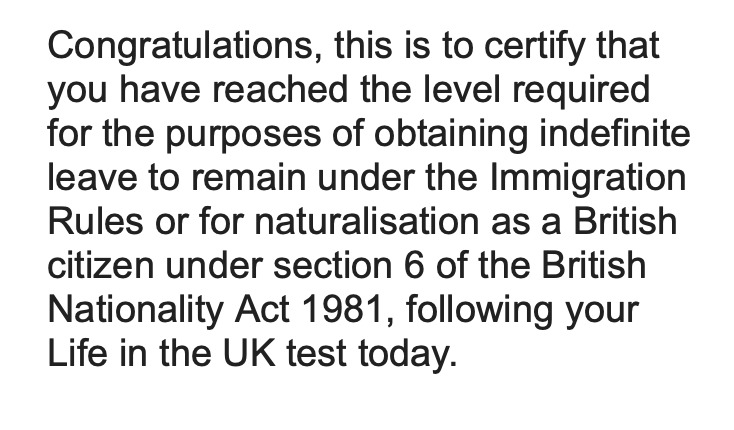
Yesterday, I sat the Life in the UK test. Sapienti sat, it evaluates your knowledge of British life, featuring 24 amazingly randmon questions one has 45 minutes to answer. These range from the times pubs open on Sundays (usually at 11 am) to the principle by which MPs are elected (first past the post). I prepared for a month: read the textbook, completed about 40 practice tests, sought variations in difficulty. In the final weeks, I suddenly started failing more often, which made me nervous (you need to answer at least 18 questions correctly, but I often only had 16-17 correct). On the metro, I re-read the chapter on the country’s history, spanning the Bronze Age to Gordon Brown.
Near the testing centre, an Asian woman around my age was raging, crying, kicking the door, cursing the staff, who threatened to report her to the Home Office. Not a pleasant atmosphere.
Inside, they checked me in a way they don’t at airports: show your ankles, show both ears, arms up to the elbow on both sides, just short of showing the anus. Cheating is punished by a 10-year ban on the leave to remain or naturalisation, I can’t imagine who would risk it.
The questions were of the “knew, but forgot” variety: which country fought against England in the Battle of Bannockburn: Scotland or Ireland? What did John Logie Baird invent: television or the ballpoint pen? Which holiday do Muslims celebrate at the end of Ramadan: Eid al Fitr or Eid al-Adha?
I left with a feeling of failure, but three minutes later, the desired email materialised in my inbox – congratulations, you have passed the test, you can proceed with your application.
I travelled home feeling completely drained. In recent years, I've been constantly facing exams, tests, checks, trials. Did I not have as many challenges in my youth? Or have I gotten older and find it harder to cope?
Speaking of age, my closest friend Julia Vydolob (47) appeared on a podcast of our other dear friend (31), Nastya Poletaeva, to discuss the acceptance of age, the very concept of it, as well as our appearance and style in this context. I admired my girls and only wished that this conversation was happening at my home over dinner. A few thoughts on this below.
I have always said and will continue to say: life becomes truly cool at 30, at 40 it becomes astonishing, and I simply cannot imagine what comes next.
I am forever grateful to us, our life experience and the support of loved ones – we are lucky to be able to enjoy age, not fear it.
Finally, how wonderful it is to go through life with friends, with whom the criterion of age is irrelevant. With Julia and Nastya I never think about where exactly we all are on the age scale; years don't matter in our communication. Having such people in my inner circle allows me to stay alive, perseptive, to think, to not become stale.
I was also struck by Julia’s argument that she doesn’t search for trends or looks to be copied in her role models, but rather strives for commonality of values. Last week I attended a public talk by Amy Smilovic, whom both Julia and I love (Julia mentions her in the interview).
Amy is founder and creative director of the fashion brand Tibi and came to London for a trunk show and a book club on her magnum opus, Creative Pragmatist, in which she dissects her approach to style and, ultimately, to life. The room gathered about 50 women of different age, shape, skin colour, gender, and income, and the conversation revolved not not so much around clothes, looks, or styling, but rather around aspirations, life stages, and values. And this is now my utmost interest and approach to dressing where it's not you for the clothes, but the clothes first and foremost for you and your personality.
Amen.
Reading: Tomorrow, and Tomorrow, and Tomorrow by Gabrielle Zevin, an unputdownable story of three friends-avid gamers, their gamedev empire and life as it goes. Sometimes there is too much inclination towards A Little Life with the protagonist being a mixed-race mysterious crippled young man of many talents and his friends creating a coccoon of love around him, but the book manages to have its own voice, and I am very much looking forward to know the end.
Listening: I saw L’elisir d’amore at the Royal Opera and highly advise those in London to follow suit! The loveliest playful and happy opera has been staged as the most comical Italy-in-the-50s-scene; Nadine Sierra’s silvery soprano gives Adina’s score life and the dramaturgy its flair. Liparit Avetisyan as Nemorino is good, but I’ve already seen him in La Traviata and to me he is lacking facets and is a bit too folkish in higher apreggios. With age and experience his Una Furtiva Lagrima may become a true gem, so far I feel he’s still searching. Anyways, go see it if you can! You’ll be delighted you did.
How amazing it is to be featured in your newsletter! I’m truly thrilled. Thank you!